Own product

PulseWeb

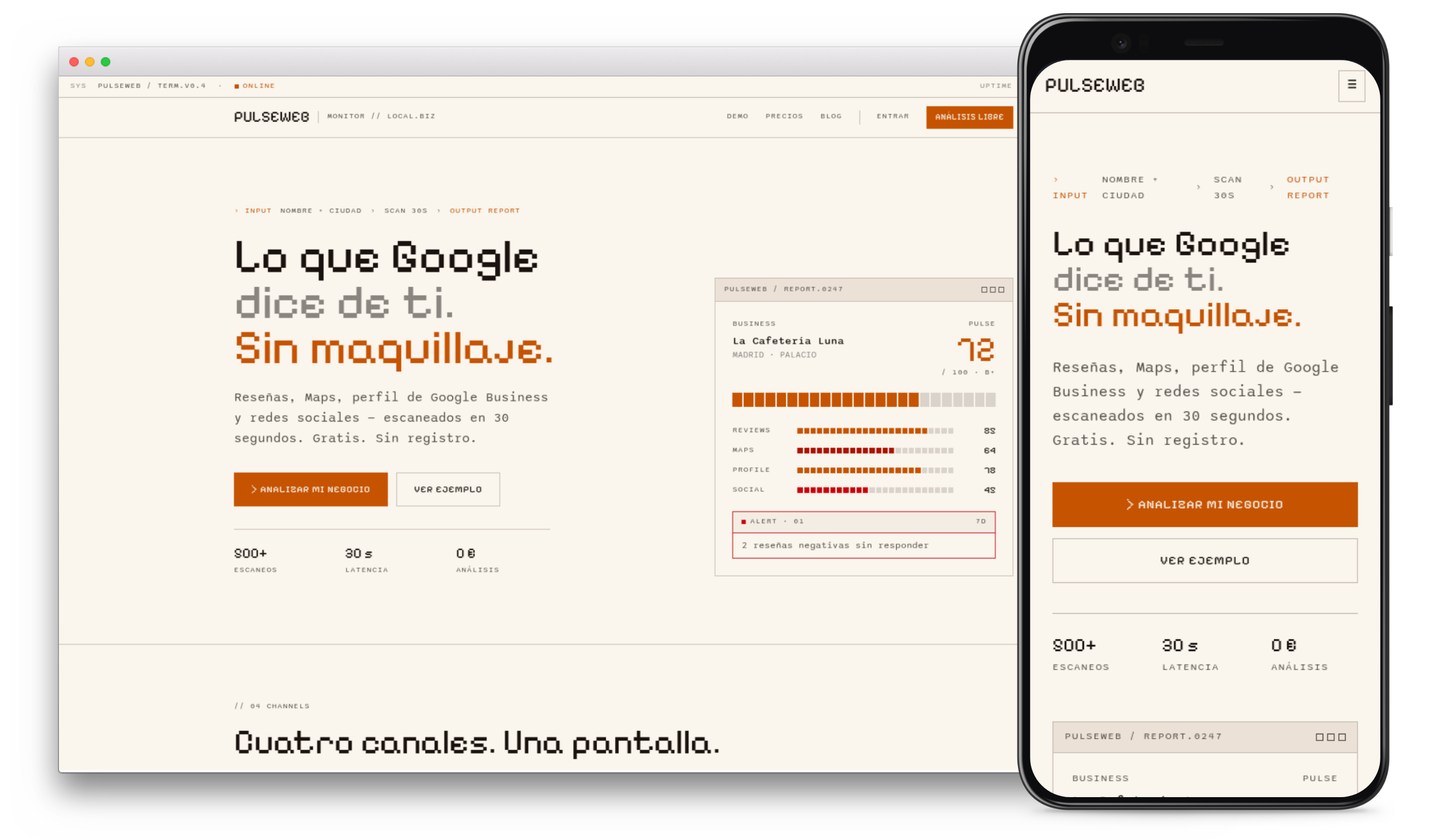
What Google says about you. No spin. In 30 seconds and no sign-up required.

Tech stack

  • Next.js 16 + React 19 + TypeScript
  • Tailwind 4 + shadcn/Radix UI
  • Framer Motion (animations)
  • Supabase (auth + database)
  • Stripe (subscriptions)
  • Resend (transactional email)
  • Zustand (state)
  • Deployed on Vercel

The technical challenge

The product lives or dies by response time. If analyzing a business takes more than 30 seconds, the visitor leaves. You have to scan four channels in parallel (Google Reviews, Maps ranking, Google Business profile, social media), normalize what each one returns and compose a coherent score, all within that target time.

The second hard part is delivering the analysis without asking anything of the visitor. No sign-up. You enter the business name and city, hit the button, and see the report. That forces you to control abuse (rate limiting by IP), manage cost per API (Google Places, Maps, etc.) and cache results per business so two back-to-back queries don't double the spend.

Then comes the SaaS part. The unregistered visitor sees a one-off report. If they want history, alerts or continuous monitoring, they go through Stripe. Accounts in Supabase with Row-Level Security, subscriptions in Stripe, transactional emails with Resend, a dedicated dashboard. An entire monetization layer added without losing the original "no sign-up" promise.

Process and decisions

A modern stack geared toward speed of first response. Next.js 16 with App Router to render the report server-side with streaming, instead of waiting for everything before showing anything. Calls to external APIs run in parallel and results are cached per business. Better a useful score in 30 seconds than a perfect report in five minutes.

Requiring prior sign-up was ruled out, even though it would have lowered cost per query. That's exactly the B2B hook: the business owner (or the salesperson pitching them something) arrives, enters the name, sees the report with no barriers, and only then decides whether they want more. Charging the friction up front killed conversion.

Supabase + Stripe + Resend instead of building auth, subscriptions and email by hand. It makes sense when what matters is that the SaaS works well, not reinventing the wheel. Each piece does its job and integrates cleanly. If any of them needs to change at some point, they're replaceable parts.

Traction

30 secondsAnalysis completed
NoSign-up required
Reviews, Maps, Google Business, Social mediaChannels analyzed
Clinics, restaurants, hair salons, auto shops, hotels, gyms, vets, lawyersTarget niches
0€Cost to the visitor

What does this mean for your project?

If your product depends on pulling from third-party APIs (Google, social media, marketing tools, ERPs, payment gateways) and unifying all of that into a single response under a target time, this project proves I know how to build it. Parallel calls, caching per analyzed entity, cost control per request and a coherent result.

It also serves as an example of a complete modern SaaS: a free no-sign-up acquisition hook, conversion to a paid account via Stripe, a private dashboard with RLS in Supabase and transactional email with Resend. An entire monetization layer integrated without giving up a very low barrier to entry.

If you need a product that scans an entity (business, website, domain, profile) by cross-referencing several sources and returns a unified snapshot, this is along those lines. And if on top of that you want to offer a free version as a hook and a paid one as recurring revenue, the whole pattern is built and working.

Want something similar?

Tell me what you have in mind and I'll tell you what I can do.